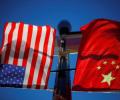
'Trump does have a master plan in mind to put pressure on India with the additional tariff of 25 per cent to get Modi to persuade Russian President Vladimir Putin to freeze the Ukraine war.' 'It has not worked so far. By end-September only we'll know for sure the future trajectory of India's oil purchases from Russia,' observes Ambassador M K Bhadrakumar.

After a year of modest returns, equity investors may anticipate gains of 10-15 per cent in Samvat 2082, which began on October 21. Although valuations have moderated from their peaks a year earlier, they remain above long-term averages, potentially limiting sharp upsides.
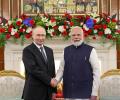
Luckily for us, a Russia that is desperate to stay relevant in an emerging multipolar world finds in India a reliable geostrategic partner. The Russian proximity to India also keeps China from exploiting its economic dominance vis a vis Russia, points out Colonel Anil A Athale (retd).

As the 50 per cent US tariffs on the Indian imports came into effect on Wednesday, the stakeholders of the diamond industry in Surat believe that the market will be affected due to US' decision only for a short period of time as India controls 90% of diamond production.

'Rate cut looks unlikely and there is reason to believe that the cycle is over.'

Equity markets this week would keenly track the upcoming GST Council meeting, macroeconomic data announcements and trading activity of foreign investors for further movement, analysts said. Moreover, developments related to tariff negotiations, global market trends and auto sales data would also drive investors' sentiment.

Sanjay Malhotra has made structural changes to banking regulation to bring down costs and increase efficiency. Plus, he kicked off a benign interest regime. But there are challenges ahead.
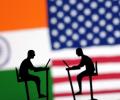
Trump administration's chief negotiator Brendan Lynch is arriving in India to hold talks on the India-US bilateral trade deal, which were impacted after the US imposed 50 per cent import tariffs on Indian goods.

Indian manufacturing sector witnessed the fastest improvement in operating conditions in over 17 years in August, driven by an increased production efficiency and healthy demand conditions, a monthly report said on Monday. The seasonally adjusted HSBC India Manufacturing Purchasing Managers' Index (PMI) rose from 59.1 in July to 59.3 in August, indicating the fastest improvement in operating conditions for 17-and-a-half years.

India's mergers and acquisitions (M&A) activity cooled in the second quarter of 2025-26 (Q2FY26), with deal value falling to $26.26 billion from $29.04 billion a year ago, according to Bloomberg data.

'The outlook for the next Samvat is more constructive, as many of the earlier drags are gradually becoming supports.'
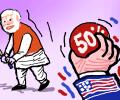
'Things may get much worse before they get better,' predicts Ajay Chhibber.

Pakistan and China are among the countries which are testing nuclear weapons, United States President Donald Trump has said to justify his administration's plans to resume testing of the US's own nuclear assets after a gap of over three decades.

From labelling India the 'Tariff King' to slapping sweeping import duties, US President Donald Trump has steadily hardened his trade stance on India. These announcements are being seen as a pressure tactic to get New Delhi to agree to demands made by the US in the proposed Bilateral Trade Agreement (BTA).

Former White House trade advisor Peter Navarro accuses India of being an 'oil money laundromat' for Russia, alleging that India's oil purchases are funding Putin's war in Ukraine. The accusations come amid existing trade tensions and tariffs imposed by the US.

Lutnick said that these countries have to understand that if "you want to sell to the US consumers, you've got to play ball with the President of the United States."
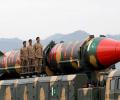
After Donald Trump became president of the United States, he unleashed economic weaponisation, upsetting the old world order, leading to much unrest. If that wasn't all, the threat of an imminent nuclear war was issued by the US, Russia, China, North Korea and Pakistan. In today's fractious times, Dr Paulos Mar Gregorios would have made a dent, notes His Holiness Baselios Marthoma Mathews III.

India and Russia are expected to unveil a major nuclear energy partnership during Vladimir Putin's visit, potentially involving Russian small modular reactors and expanded cooperation as India pushes toward its 100-GW nuclear goal by 2047.

Indian private sector and State-run refiners continued to receive crude oil from Russian suppliers even after November 21 -- the winding-down date for US sanctions on supplies from leading Russian oil producers imposed in October -- as new intermediaries sprung up in West Asia to sell the oil, according to senior refining sources and ship tracking data.

India's economy could reach $20.7 trillion in terms of purchasing power parity (PPP) by 2030 and may emerge as the second-largest economy by 2038 with $34.2 trillion GDP, an EY report said on Wednesday. The report also said that with appropriate countermeasures, India can limit the adverse impact of higher US tariffs on selected Indian imports to about 10 basis points of real GDP growth.

iPhone-maker Apple on Tuesday announced that it will open a new store in Pune next week. The latest move marks a significant expansion for Apple in the country, offering customers in Pune new ways to explore and purchase Apple products, as well as experience Apple's services in person, the company said.
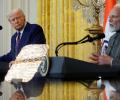
The deal fell through over unresolved disagreements over contentious issues, mainly on agriculture and automotive sector tariffs.

The consumer price index (CPI)-based inflation hitting an all-time low in October would encourage the six-member monetary policy committee (MPC) of the Reserve Bank of India (RBI) to cut the policy repo rate in its upcoming December 3-5 meeting. However, the July-September GDP growth, expected to be above 7 per cent, may act as a deterrent.

Stock market investors this week would track the renewed tariff tensions between the US and China, domestic inflation data, besides, quarterly earnings from blue-chips HCL Tech, Infosys and Reliance Industries would also drive the momentum in equities, analysts said.

India stares at the risk of an influx of Chinese products as US tariffs on a range of Chinese goods, including solar panels, electric vehicles, lithium-ion batteries, syringes, and steel, are set to take effect from September 27. With higher tariffs reducing China's access to the US market, there is concern that China may divert its exports to other markets, including India, which could lead to potential dumping of goods. This situation could challenge Indian industries, particularly in sectors where competition with Chinese products is already fierce.

Analysts at Morgan Stanley have updated their outlook for the Indian markets, and they now expect the Sensex to hit the 107,000 mark by December 2026 in a bull-case scenario, translating into an upside of 26 per cent from current levels.

Healthcare major Max Healthcare Institute delivered a healthy performance in the second quarter (July-September) of 2025-26 (Q2FY26). Strong patient volumes and average revenues not only boosted the top line but also aided the operating performance.
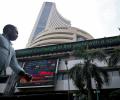
From the Sensex pack, Asian Paints, ICICI Bank, PowerGrid, Larsen & Toubro, Bajaj Finserv, Bharti Airtel, Sun Pharmaceuticals, Maruti Suzuki India, Axis Bank, UltraTech Cement and HCL Technologies were the only gainers. On the other hand, Eternal, Tata Motors' commercial vehicles arm, Mahindra & Mahindra, Tata Steel, Bharat Electronics Ltd, Tata Motors Passenger Vehicles, Trent, Tata Consultancy Services, Hindustan Unilever, and Infosys were among the laggards.

Reliance Jio's major subscriber losses continued for the third straight month with 7.96 million users leaving the telecom operator in September, even as the state-owned BSNL stood out as the lone gainer, data from the Telecom Regulatory Authority of India (Trai) showed on Thursday. Market leader Jio's subscriber loss has continued since July when the three private telecom operators - Jio, Bharti Airtel, and Vodafone Idea (Vi) - brought in a broad-based hike in tariffs.
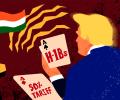
White House Press Secretary Karoline Leavitt clarifies President Trump's stance on H-1B visas, emphasizing his priority for American workers while acknowledging the need for skilled foreign workers to train them in specialized industries.

Equity benchmarks face a key test as investors weigh consumption revival hopes against tariff pressures and weak earnings. Amidst this, HSBC has outlined tailwinds and risks that could cap gains.
Trump also said he is "very disappointed" that India would be buying "so much oil" from Russia.

The White House trade advisor's remarks came on a day US President Donald Trump announced that India and the US are continuing negotiations to address the trade barriers.

'Indian markets may underperform global peers for the next two quarters.' 'But beyond that, India should catch up and resume its long-term growth path.'

From the Sensex firms, Tata Motors jumped the most by 5.54 per cent, followed by Kotak Mahindra Bank, Trent, Sun Pharma, Axis Bank, and ICICI Bank. However, Bajaj Finance, State Bank of India, UltraTech Cement and Tata Steel were among the laggards.

LG Electronics India saw its net profit decline by 27.3 per cent due to margin pressures witnessed in the second quarter. Its net sales in the quarter marginally rose 0.9 per cent to Rs 6,170.4 crore in the July-September quarter.

Former US National Security Advisor John Bolton says President Trump's policies have damaged US-India relations, pushing New Delhi closer to Russia and China.

Foreign portfolio investors (FPIs) remained net sellers of Indian equities in September, withdrawing Rs 23,885 crore (around $2.7 billion) and taking year-to-date outflow to Rs 1.58 lakh crore ($17.6 billion).

Losing subscribers for the fourth straight month, Reliance Jio witnessed 3.76 million users leave the telecom operator in October, data from the Telecom Regulatory Authority of India (Trai) showed on Monday. Meanwhile, Bharti Airtel reversed three months of decline, and added 1.92 million users, indicating it has overcome the impact of the broad-based tariff hikes imposed by private sector telcos in July.

India is seeking either an exemption or a longer timeline on the pharmaceutical tariffs, expected to kick in by July 31.
